Four Ways to Make Your Blog Posts More Readable

Find out four ways to make your blog posts more readable.

Add to DeliciousAdd to DiggAdd to FaceBookAdd to RedditAdd to StumbleUponAdd to TechnoratiAdd to Twitter
Whether you’re newcomer to online writing or have been in the field for a while there are many great insights to glean from the book, Writing for the Internet: A Guide to Real Communication by Craig Baehr and Bob Schaller.  The book addresses issues applicable to writers of all types of online content, but as a blogger I found it particularly helpful to apply the messages to the writing of blog posts.

The authors point out that there are many challenges for writers of online content and that by being aware and paying attention to the readability and usability of your material, the overall experience for readers will be improved. For purposes of this post, I’m going to stay focused more specifically on four good practices for bloggers to adhere to:

1) Remember content is not limited to the written word.

Content is composed of mixed media forms, and it is the Internet writer’s challenge to make them work together seamlessly.  This means that including images, video and audio clips, and staples such as hyperlinks can all work in sync with one another within a blog post.

2) Strive to keep up with new technologies.

Strive to have a “surface awareness of the latest technologies, new trends and tools that may improve the quality of written products.” In addition, a familiarity with a variety of tools is also necessary.  What’s here today will be old technology before you know it.  Find ways to keep up and work it into your week and workload.  I recently wrote about six resources to keep up with social media that I use on a regular basis to keep up with social media.  Make a list of your go-to places and visit them regularly.

Continue reading “Four Ways to Make Your Blog Posts More Readable”

How to Find Ideas for Your Blog Posts

Writers of all genres talk about periods of being blocked, when ideas don’t come easily and the writing has stopped flowing. It shouldn’t be any surprise then that bloggers would experience times like that, too. Sometimes writers may need to find the right prompt or idea to get them moving again.


Add to DeliciousAdd to DiggAdd to FaceBookAdd to Google BookmarkAdd to RedditAdd to StumbleUponAdd to TechnoratiAdd to Twitter

Article first published as How to Find Ideas for Your Blog Posts on Technorati.
;

Writers of all genres talk about periods of being blocked, when ideas don’t come easily and the writing has stopped flowing. It shouldn’t be any surprise then that bloggers would experience times like that, too. Sometimes writers may need to find the right prompt or idea to get them moving again.

While I find many ideas for posts online after reading some of my favorite resources, I still have days when I’m doing more absorbing than writing. A few of those are okay but what happens when it starts to stretch on and you find that you haven’t updated your blog in over a week or more? That’s when I usually find a visit to a bookstore or the library as a cure for wayward writing. For me, I find inspiration when I’m surrounded by thousands of books.

Yesterday you could say I hit a gold mine when I stumbled upon the book, 100 Ways to find Ideas for Your Blog Posts by Steven Aitchinson. (By the way, the list of 100 ideas is also available online but is superb in a bound printed format!) I already do a good number of things mentioned in the book but there were many I hadn’t thought of before.

Here are five of my favorite new ideas for finding inspiration for blog posts:

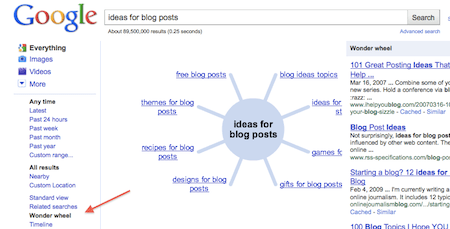
1. Google Wonder Wheel. This one is just plain fun. The tool is wonderful for people who like to see things visually represented.

Here’s how Steven explains it: “The Google Wonder Wheel is an amazing tool which can spin ideas out of nothing. You can find the Wonder Wheel on the search at google.com, when you search on something there is a + box with ‘Show Options’ on it, you will find the Wonder Wheel on the list on the left hand side. Type in a phrase of your subject and Google Wheel will come up with similar phrases about your subject.”

UPDATE: Since this post was published, wonder wheel has since been discontinued.

Continue reading “How to Find Ideas for Your Blog Posts”

Tim O’Reilly, Thinking Hard About the Future, ‬Web 2.0 Expo NY 2010

Tim O’Reilly gave a talk at Web 2.0 Expo NY 2010 entitled, “Thinking Hard About the Future”. Some fascinating historical examples about innovation and inspiration for people engaged in inventing the future. I recommend watching the video. And then when you’re done, if you’re not already doing it– do as Tim suggests, “Go Out, Create & Have Fun.”

Tim O’Reilly gave a talk at Web 2.0 Expo NY 2010 entitled, “Thinking Hard About the Future.”  Some fascinating historical examples about innovation and inspiration for people engaged in inventing the future. I recommend watching the video. And then when you’re done, if you’re not already doing it– do as Tim suggests, “Go Out, Create & Have Fun.”

Infographics as Marketing Strategy: 12 Take-Away Points for Businesses

Infographics are big. They’re cropping up all over the mediasphere and for good reason. Pictures grab attention. In many cases they get the message across far better than words. How do they do it?

Add to DeliciousAdd to DiggAdd to FaceBookAdd to Google BookmarkAdd to RedditAdd to StumbleUponAdd to TechnoratiAdd to Twitter

Article first published as Infographics as Marketing Strategy on Technorati.

Infographics are big. They’re cropping up all over the mediasphere and for good reason. Pictures grab attention. In many cases they get the message across far better than words. How do they do it?

How Pictures Grab Attention

Clive Thompson writes in the October issue of Wired Magazine, “And if you believe the visualization experts, a new language of pictures may be precisely what we need to tackle the world’s biggest challenges. Thompson quotes David Sibbet, a visualization expert who has spent the past three decades consulting for larger firms. “If you want everyone to have the same mental model of a problem, the fastest way to do it is with a picture.” Thompson suggests that these images provoke aha moments far often than typed or verbal summaries.

Jennifer Aaker and Andy Smith, authors of The Dragonfly Effect explain, “Pictures trump words in terms of grabbing attention because they’re composed of lines and curves that are more complex, and therefore distinctive, than the lines and curves that compose words.”

Need more convincing? Aaker and Smith tell us too, “a study at the University of Pennsylvania showed that in presentations, when information is conveyed orally, people retain only 10 percent of the content. But when a presentation includes visuals and words, the number increases to 50 percent.”

Infographics are much more than a pretty picture. They provide users with four distinct elements:

1. same mental model
2. attention-getting mechanisms
3. content retention
4. engagement from start to finish

How Companies Use Infographics for Marketing

In a recent case study about Infographics, Ken Lyons provides a very generous and revealing overview about not only what led to the success of Infographics  for his firm, he shares valuable how-to information with the assistance of Chris Angus of Warlock Media, who worked with him on the design of their Infographics.

Continue reading “Infographics as Marketing Strategy: 12 Take-Away Points for Businesses”

How Adults are Using Mobile Phones [Infographic]

Flowtown does it again with this informative infographic on how adults are using mobile phones.

Following up on yesterday’s post, 12 Reasons for Businesses to Consider Mobile Advertising, it’s interesting to see how adults are using mobile phones with this infographic from Flowtown.

12 Reasons for Businesses to Consider Mobile Advertising

The question many businesses are asking these days is whether it pays for them to advertise via SMS (Short Message Service) or what’s commonly referred to as text messaging. mobileSQUARED published an industry report, “Conversational Advertising,” in June 2010 (commissioned by SinglePoint) which offers some intriguing facts and figures.

Article first published as 12 Reasons for Businesses to Consider Mobile Advertising on Technorati.

The question many businesses are asking these days is whether it pays for them to advertise via SMS (Short Message Service) or what’s commonly referred to as text messaging. mobileSQUARED published an industry report, “Conversational Advertising,” in June 2010 (commissioned by SinglePoint) which offers some intriguing facts and figures.

Let’s take a look at the 12 reasons why you’d want to seriously consider mobile advertising now and in the years ahead:

1. Mobile Usage Hours Per Year
Mobile phone is in the possession of the average user for 5,840 hours per year via conversational advertising.

2. Rate at Which Text Messages are Read
Messages are read within 3 minutes of their delivery. Over 99% of all text messages are read by the recipient.

3. Ability to Get to Users All Times of Day
According to research conducted by Pew Internet in September 2009, texting is the primary reason that teenagers will sleep with their cell phone next to them.

4. Mobile Advertising Spending
Messaging dominated mobile advertising spending in the last decade.

5. Mobile Advertising App Activity
80% of apps on the iPhone App Store are downloaded 10,000 or less.

6. Far-Reaching
The mobile Internet is becoming a mainstream activity for hundreds of millions of users around the world (in developed, and also developing countries where mobile is often the first screen.)

Continue reading “12 Reasons for Businesses to Consider Mobile Advertising”

6 Resources to Help You Stay Current with Social Media

Even the most savvy marketers wake up some days feeling that there’s way too much information floating around the social mediasphere for them to keep up. Unless you have a specific department or a designated manager whose job it is, you’ll want to find a way to stay on top of social media. So what do you look for and where should you focus your attention?

Article first published as 6 Resources to Help You Stay Current with Social Media on Technorati.

Even the most savvy marketers wake up some days feeling that there’s way too much information floating around the social mediasphere for them to keep up. Unless you have a specific department or a designated manager whose job it is, you’ll want to find a way to stay on top of social media. So what do you look for and where should you focus your attention?

It’s important to find a core group of blogs. websites and tools that you consider as faithful go-to resources. What makes something worth returning to? For me a blog that has current up-to-date posts, high quality writing, research, statistics, interesting infographics, a good take away (e.g. a link, book, video, podcast) are some of the things I typically look for.

Here are six resources which are a big part of my social media daily exercise routine:

1. Mashable
While I may spend the bulk of my time within Mashable’s social media category, I will also see what’s happening across the other categories e.g. business, entertainment, tech, web video, Apple and mobile. I like seeing the number of tweets, and shares on Facebook. I’m a big believer in blog commenting and I take the time to read comments others have posted. I often find suggestions within a comment which I may not have come across otherwise.

2. Alltop
Alltop aggregates news and headlines from across the web. I have the social media page bookmarked on my computer. I scan the page daily for titles which catch my attention (titles and headlines do make a difference!) I also find it helpful that Alltop provides a list of the five most recent posts for each blog.

3. Delicious
I’m a big fan of social bookmarking and Delicious in particular―I’ve been using it for several years. I’m often surprised that it’s overlooked by so many people as a valuable resource. Not only do I save links with the title, description and tags so that I will find the post again, I like to see the other delicious users who have saved the same URL and the list of the links which they recommend.

Continue reading “6 Resources to Help You Stay Current with Social Media”

Hello Blog!

Like the computer tutorials which displayed “Hello World”, I offer “Hello Blog”for me and for you. Happy Labor Day and Happy Blogging!

This might be the longest break I’ve ever taken from blogging. Scratch that. It IS the longest break!


Even though I haven’t sat down to compose posts now for a couple of weeks, I’ve found myself musing on topics and actually writing the content in my head. I’m always looking for ideas–in the media, person-to-person exchanges, as I’m perusing bookstores and magazine racks, online and offline. Why? Simply, because I love it.

When I first discovered blogging a few years ago it had come at time when I was beginning to take myself more seriously as a non-fiction essay writer and blogging became a natural extension of that writing. I’ve become enamored of the medium. The short form. The casual writing style. The ability to link and include photos and videos. To have an opportunity to interact with readers and other writers.

I’m still writing creative non-fiction essays and in fact, I’m working on a new piece simultaneously as I work on a longer blog post for a client. Blogging helps my non-fiction writing and vice versa.

I had to smile when I saw the link to Don Martelli’s post, Five Tips to Kill Bloggers Block, in my Google Alert the other day. As Don says, “If you have a blog, you’ve been there before.” I took it as an omen that I was supposed to be cracking my blogging block wide open.

As I write this Labor Day post, I’m thinking about all the ways the Fall brings change and ramping up in day-to-day schedules which were more laid back and on a summer hiatus. I’m ready to get back to the work which has fallen (I have to admit) a little to the wayside in these last days of summer. I’m hoping that the time my writing ideas have been spent simmering on low will be ready to come to a full and fruitful boil.

Wishing you a Happy Labor Day and Happy Blogging!

Beyond Keywords: The Search for Engaging Content and a Meaningful Brand Experience

Publish. Post. Update. By now you can probably hear those words in your sleep.

See the full post published on MyAdEngine.

Publish. Post. Update. By now you can probably hear those words in your sleep.

See my post published on MyAdEngine.

Branding in the 2010s: When the Look of Social Media Doesn’t Fall (Too) Far from the Tree

We can gain many insights into the 1960s ad industry when we read the new book, Mad Men Unbuttoned: A Romp through 1960s America, by Natasha Vargas-Cooper. The author, a self-described Mad Men fanatic, takes us in and out of the office suites of Sterling Cooper and through memorable years in advertising history. She writes eloquently. Even about things you might think would be otherwise mundane–like typefaces.>>Read more

Article first published as Branding in the 2010s on Technorati.

We can gain many insights into the 1960s ad industry when we read the new book, Mad Men Unbuttoned: A Romp through 1960s America, by Natasha Vargas-Cooper. The author, a self-described Mad Men fanatic, takes us in and out of the office suites of Sterling Cooper and through memorable years in advertising history. She writes eloquently. Even about things you might think would be otherwise mundane–like typefaces.

“It is fitting,” she says, “American Airlines changed its logo in 1961 to a Helvetica font. Helvetica is neutral. Helvetica is explicitly clear. Helvetica has no formal meaning, no historic roots in carnival posters, newspaper presses, or the Palmer cursive most children were learning. It was newer than the airplanes themselves.”

If fonts were used in the 1960s to evoke modern efficiency as Mia Fineman of Slate suggested regarding the use of Helvetica, what can be said about the fonts used in websites today? Steven Coles suggests that Facebook’s Kalvika font is amongst several that “have the potential to become timeless classics.” Some of the web 2.0 fonts are futurists, “reflecting a look that says ‘tomorrow’s techno’.”

Have you ever wondered what the name of some of your favorites are? Check out the list, e.g. Twitter’s Pico Alphabet, flickr’s Frutiger Black, Technorati’s Neo Sans Medium, YouTube’s Alternate Gothic No. 2, Google’s Catull BQ, hulu’s Futura MDd BT, Linkedin’s Myriad Pro Bold–to name but a few.

At another point in Mad Men Unbuttoned, Vargas-Cooper mentions the artwork of Charley Harper whose “Morton Salt ads are seen in most everyone’s office at Sterling Cooper.” Harper, she tells us, drew for Procter & Gamble, Ivory, Morton Salt and Ford Times magazine throughout the 1950s and early 1960s.

Maybe it’s just me but do Harper’s bird illustrations remind you of the artwork of any social networking web site you know? (Hint: Twitter, anyone?) Don’t blame Simon Oxley, who had been licensed to do Twitter’s bird graphic– since legend has it that he was, “paid the price of a sandwich through iStockphoto.”

Continue reading “Branding in the 2010s: When the Look of Social Media Doesn’t Fall (Too) Far from the Tree”