Location-Based Services

This past week I wrote about Location-Based Services and the Factors and Considerations for B2C and B2B Marketers for a new post on GigCoin’s Blog.

This past week I wrote about Location-Based Services and the Factors and Considerations for B2C and B2B Marketers for a new post on GigCoin’s Blog. Personally I have only used FourSquare once and haven’t tried Gowalla or any of the other popular location based services.

I had an opportunity to ask questions of Aaron Strout and Simon Salt who have both written books on the topic and also spoke to a number of business people about the ways they have used location services for their businesses.

I did learn a lot about the future of location-based marketing and would like to share it with you. You can read the full post on GigCoin’s blog.

Have you been using location-based services? What do you think about using them for marketing for your business?

Writing, Writing, Writing

I hate getting behind in updating my blog. I really do. But the good news is that I have had a number of posts on other sites in the interim and several posts which are still waiting to be published.

I hate getting behind in updating my blog.  I really do. But the good news is that I have had a number of posts on other sites in the interim and several posts which are still waiting to be published.

The ones which have gone live in the past few weeks include posts on WebDesigner Depot, GigCoin and Technorati. One of the things I love about writing these posts is doing the research and learning about a particular topic, and of course, I love the writing.

In several posts on GigCoin, I put out requests for information on HARO and had the opportunity to hear from 40+ business people who have run Facebook contests, created Facebook ad campaigns and use Facebook pages for their businesses. I’ve learned a tremendous amount from the research for these posts and from the contributors.

My post on WebDesigner Depot on The Art of Facebook Page Design was very enjoyable to do. It was a round-up of the 50 brand Facebook pages with the most fans and a look at how they’ve created the artwork for their pages. Very eye-opening!

And, I had the opportunity to read Phil Simon’s new book, The New Small, and wrote a review of the book which was published on Technorati. The New Small is a refreshing take on technology and small business, and portrays how passionate people can be about their work when technology truly supports their efforts.

There are several posts already submitted, which will be published in the next couple of weeks and more posts in process. I’ll keep you posted on the new titles.

What are you working on?

104 Tips to Enhance Your Social Media Presences

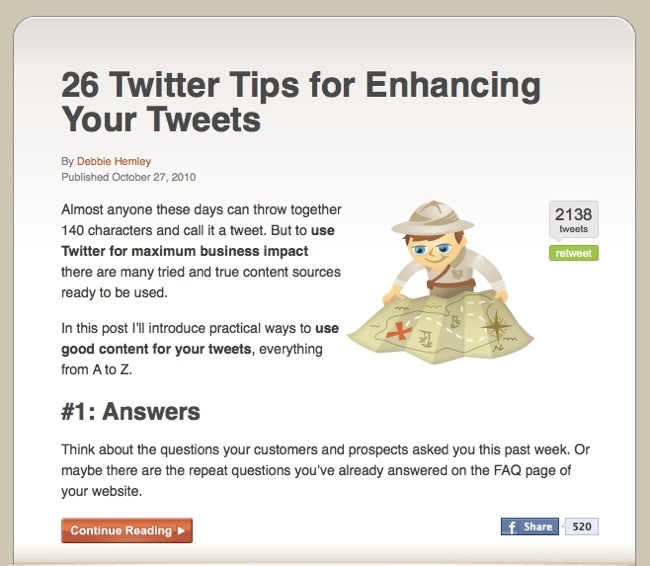
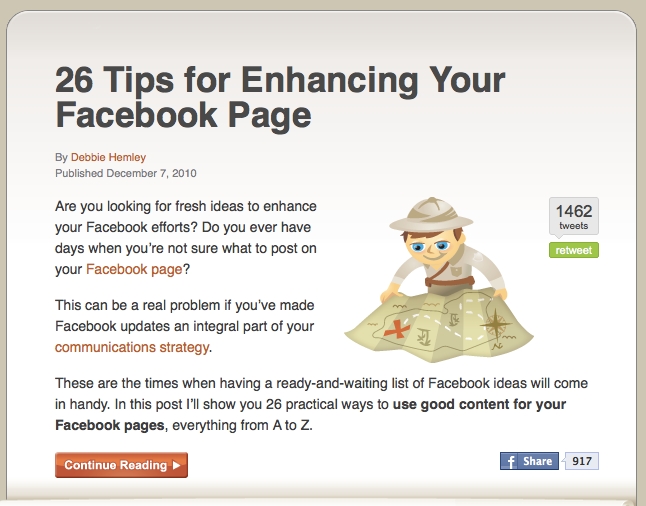
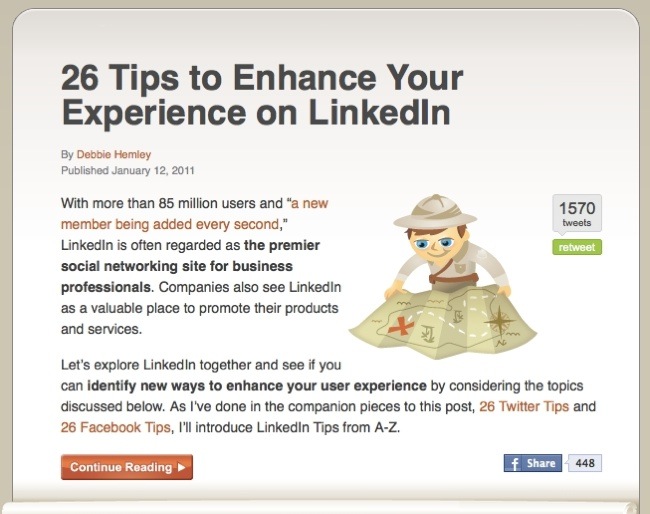
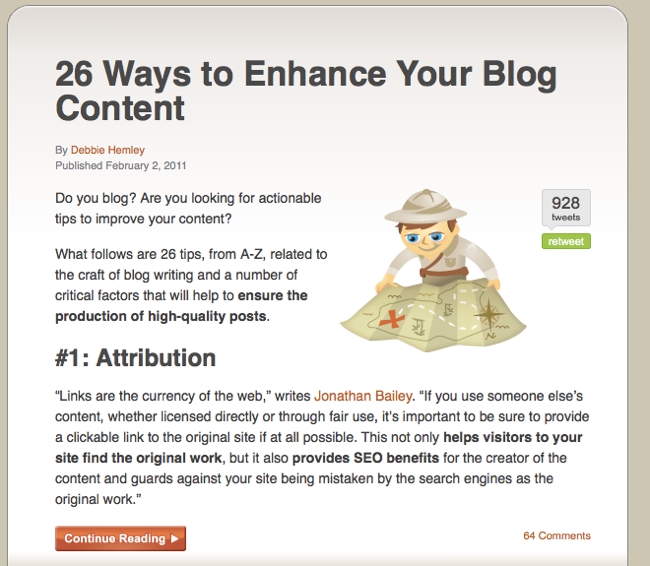
One of the fun things about blogging is creating a series of blog posts. When I wrote, 26 Twitter Tips for Enhancing Your Tweets, I didn’t know at the time that I’d go on to create three more posts with a similar approach. But the first one was very well received by readers on Social Media Examiner, retweeted 2138 times (at the time of this writing) and so I decided to take the approach of finding tips A-Z to create tips for Facebook, LinkedIn, and Blogging. Now there are 104 tips total!

One of the fun things about blogging is creating a series of blog posts. When I wrote, 26 Twitter Tips for Enhancing Your Tweets, I didn’t know at the time that I’d go on to create three more posts with a similar approach. After the first one was well received by readers on Social Media Examiner, (retweeted 2138 times at the time of this writing), I decided to take the approach of A-Z tips for Facebook, LinkedIn, and Blogging. Now there are 104 tips total!

Using a list approach to blog posts can be very effective. And by adding linked resources, I’ve found readers often like to do a little more research on topics they’re interested in.  Lists also improve the readability of a post by creating nicely chunked content which is easy for people to make their way through. Having a catchy approach e.g. A-Z approach, gives the post a little extra pizazz, too.

When you’re writing posts that cover a lot of material it is helpful to find a way to present the material in a way your readers will be able to take in and absorb.

Click on images to go to full post


LinkedIn: Recent Lessons Learned

Recently, I set out to learn more about LinkedIn for research I was doing for two upcoming blog posts. LinkedIn had been my most under-utilized social networking presence and it hadn’t exactly wowed me previously…Sometimes I think we end up learning what we need to learn what we write new blog posts. And this was really the case for me with these two recent posts.

Recently, I set out to learn more about LinkedIn for research I was doing for two upcoming blog posts. LinkedIn had been my most under-utilized social networking presence and it hadn’t exactly wowed me previously. I was mostly on it because others suggested it was a good place for me to be. For the longest time my profile was incomplete and I ignored the percentage read-out on the right-hand side of the page to get it to 100% completion. Eventually one day I sat down and added the missing content and got the page to 100% in very little time. There, I thought.  I did it. Enough of that. But when I embarked on the LinkedIn research I found that LinkedIn has added many new features and it’s a lot more useful than I originally thought.

Sometimes I think we end up learning what we need to learn when we write blog posts. And this was really the case for me with these two recent posts. I also had the opportunity to speak with Ryan Roslansky, LinkedIn’s Director of Product Management, in a phone interview who was enormously helpful in showing me the new features of LinkedIn’s company pages.

The first of the two posts 26 Tips for Enhancing Your LinkedIn Experience was published on Social Media Examiner, and the second, How to Use LinkedIn for Your Web Design Business was published on WebDesigner Depot. While the second one speaks specifically to designers, you’ll see that the steps for professionals in any industry are really the same and will only be slightly altered to take into consideration certain factors (e.g. keywords, industry-specific groups, etc.)

Check out the posts to learn more about the in’s and out’s about LinkedIn. Today, I learned about LinkedIn Swarm on LinkedIn’s blog. If you don’t already receive it by email, signing up for new posts will help keep you up-to-date on LinkedIn news.

What do you find most helpful about being on LinkedIn?

Twelve Months of Blog Posts: A Look Back at 2010

A blog post can touch you in the right way at the precise time for a number of reasons. For me, a post which I consider “good” is one which:

1. teaches something new
2. provides a link to a useful tool or resource
3. is helpful to me in my work at exactly the time I’m looking for it
4. is original and unique
5. is well-researched and well-written
6. is an inspiration to other bloggers

I’m someone who bookmarks url’s each month. Up to now, I’ve been using Delicious for social bookmarking, and as an aside I hope that it will survive and thrive in the New Year. I bookmark url’s so I can refer back to them and share them with others. For this post, I looked back at what I’ve bookmarked during the year and chose one from every month. In all but one of the cases, the post was written in the month I saved it.

What posts did you bookmark this year? Share the links in the comments below.

A blog post can touch you in the right way for a number of reasons. For me, a post which I consider “good” is one which:

  1. teaches something new
  2. provides a link to a useful tool or resource
  3. is helpful to me in my work at exactly the time I’m looking for it
  4. is original and unique
  5. is well-researched and well-written
  6. is an inspiration to other bloggers

I’m someone who bookmarks url’s every month. Up to now, I’ve been using Delicious for social bookmarking, and as an aside I hope that it will survive and thrive in the New Year.  I bookmark url’s so I can refer back to them and share them with others. For this post, I looked back at what I’ve bookmarked during the year and chose one from every month. In all but one of the cases, the post was written in the month I saved it. Click on the image to access the full post.

Looking forward to a new year of inspirational and educational blog posts. Season’s Greetings and Best Wishes for a Happy and Healthy New Year! Thanks as always, for reading!

What posts did you bookmark this year? Share the links in the comments below.

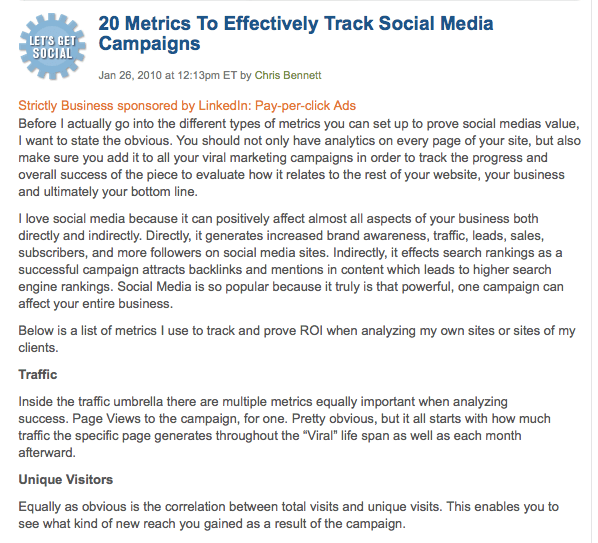
January 2010

20 Metrics to Effectively Track Social Media Campaigns by Chris Bennett


February 2010

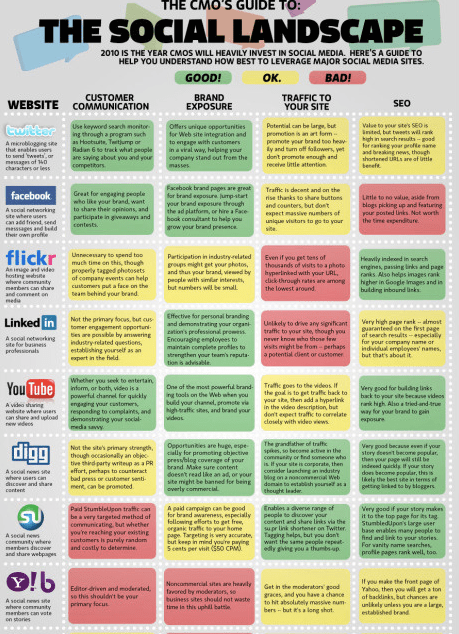
The CMO’s Guide to the Social Media Landscape, CMO.Com
 

March 2010

How To: Write a Strong Title for Your Blog Article by Misty Belardo

April 2010

5 Reasons Readers like Numbers in a Headline by Brandon Cox

May 2010

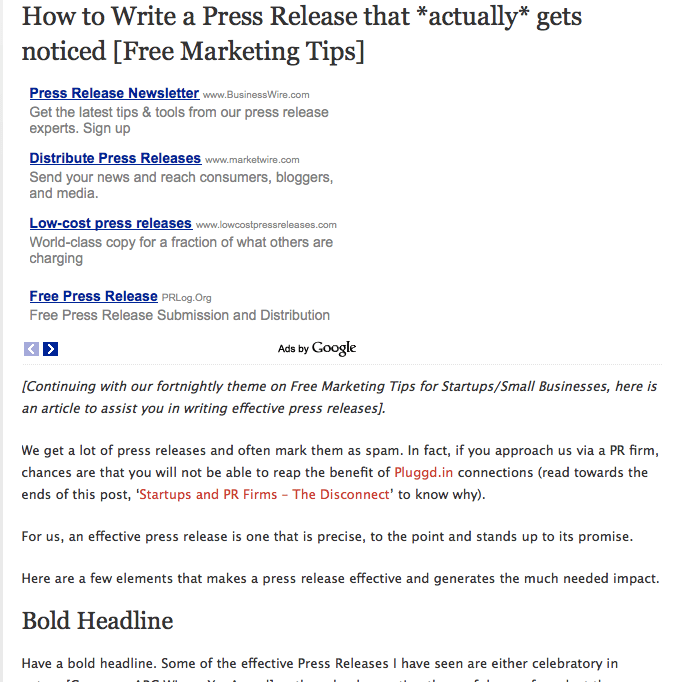
How to Write a Price Release that *actually* gets noticed by Sinha
June 2010

How To: Use Social Media for Lead Generation by Erica Swallow
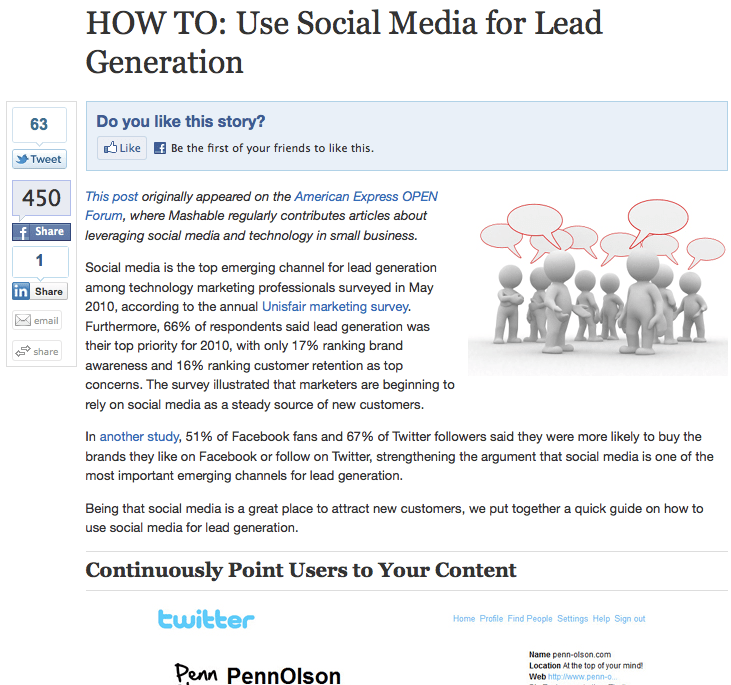
 

July 2010

Cool Tool Review: Creative Commons A Review by Todd Hoskins
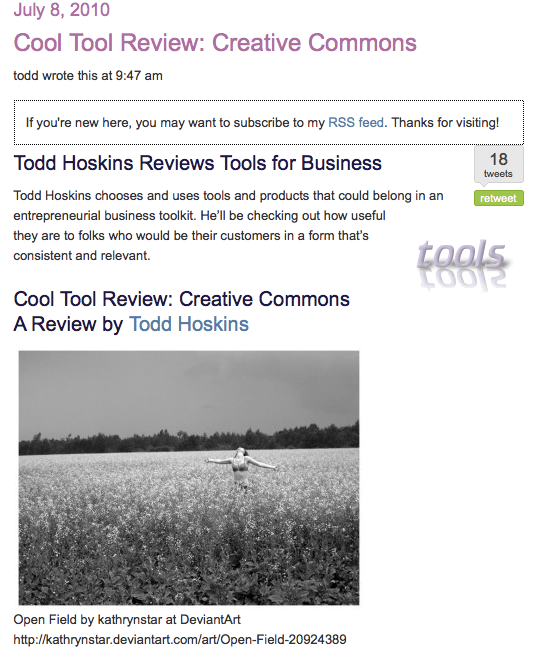
August 2010

The 10 Best Infographics for Internet Marketing Pros by Andy Beal
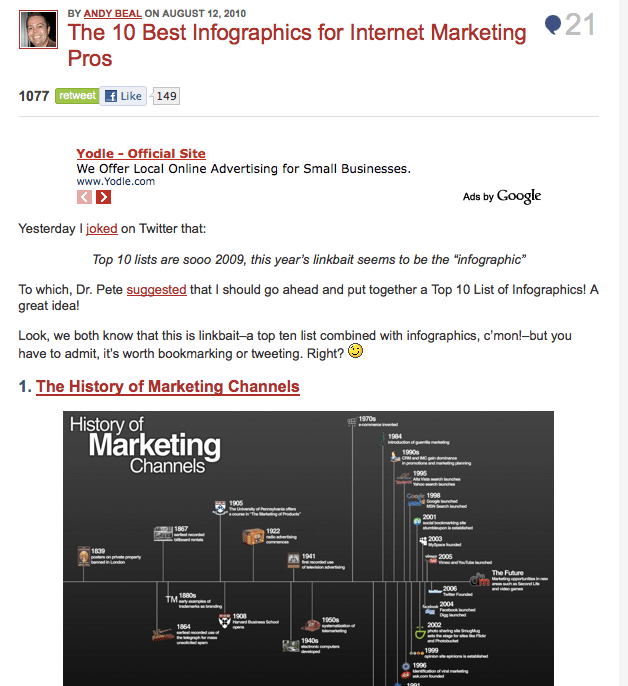
September 2010

21 Creative Ways to Increase Your Facebook Fanbase by Mari Smith
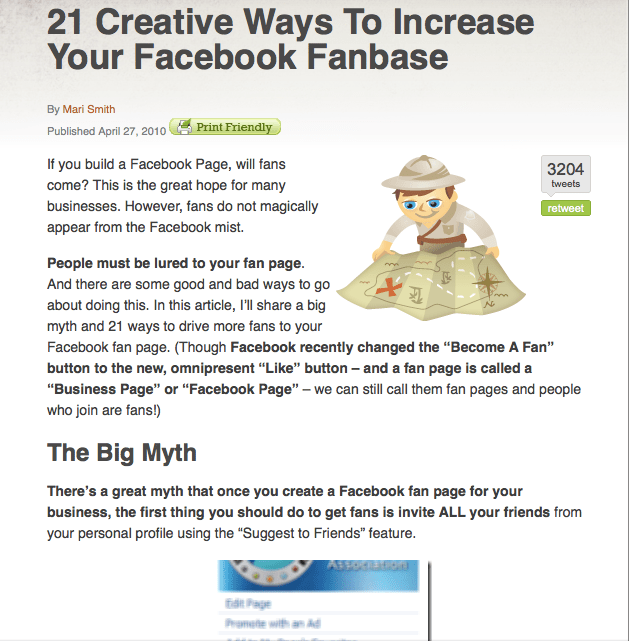


October 2010

6 Ways to Optimize Your Blog for Search Engines by Jim Lodico 

 

November 2010

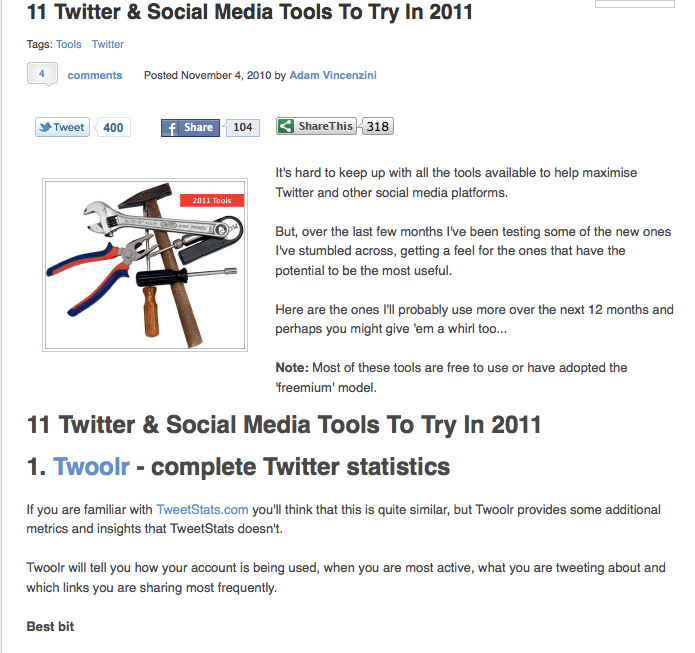
11 Twitter & Social Media Tools To Try in 2011 by Adam Vincenzini
 
December 2010

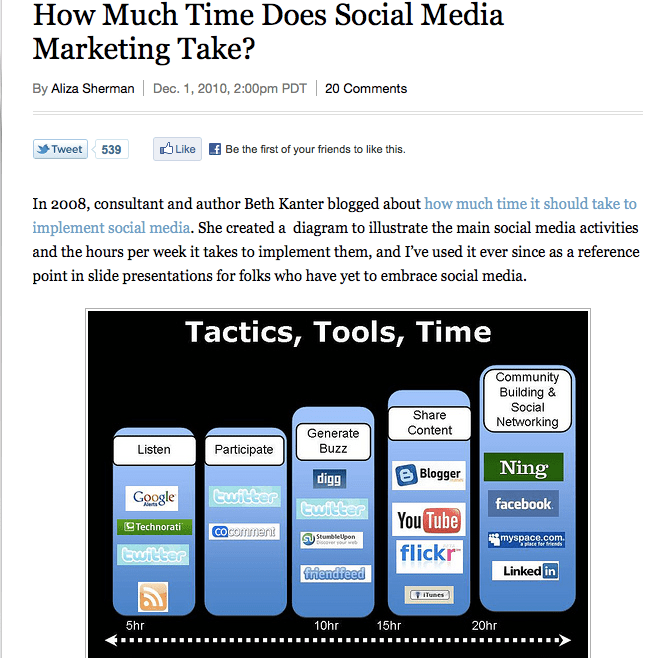
How Much Time Does Social Media Marketing Take? by Aliza Sherman


What posts did you bookmark this year? Share your comments and links in the space below.

[Infographic] History of Social Media & Social Media Bookmarking

Infographic on “History of Social Media” via Skloog. History begins with Postal Service in 550 BC right through to Google Buzz in 2010—with lots in between!

Infographic  “History of Social Media” via Skloog. History begins with Postal Service in 550 BC right through to Google Buzz in 2010—with lots in between!

[Click image to enlarge]

History of Social Media

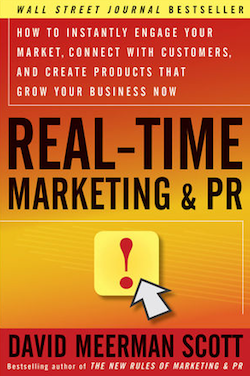
Book Review: Real-Time Marketing & PR by David Meerman Scott

There’s a lot to love about “REAL-TIME MARKETING & PR: How to Instantly Engage Your Market, Connect with Customers and Create Products that Grow Your Business,” the new book by David Meerman Scott.

There are stories about organizations who did it right, and acted swiftly when their brand’s reputation was at stake. And stories about companies who ignored the moment, missed the boat either by not making a statement, offering an apology, or listening to customers who asked to be heard. Scott retells the story about Dave Carroll and how United Airlines broke his guitar, a story I’ve heard a number of times but never get tired of hearing.

There’s a lot to love about “REAL-TIME MARKETING & PR: How to Instantly Engage Your Market, Connect with Customers and Create Products that Grow Your Business,” the new book by David Meerman Scott.

There are stories about organizations who did it right, and acted swiftly when their brand’s reputation was at stake. And stories about companies who ignored the moment, missed the boat either by not making a statement, offering an apology, or listening to customers who asked to be heard. Scott retells the story about Dave Carroll and how United Airlines broke his guitar, a story I’ve heard a number of times but never get tired of hearing. There’s the fascinating details about the viral “United Breaks Guitars” YouTube videos, and how United Airlines went missing when they should have  made an appearance.

In my opinion, Scott’s telling of the story is a particularly good one. Perhaps what’s greatest is the references to Jim Laffoley, the President of Carlton Cases, who saw an opportunity real-time, and offered to provide Dave Carroll and his band cases for the band’s upcoming tour. Laffoley didn’t stop there, he came up with a new product, Carroll’s Traveler’s Edition Guitar Case, and an aggressive price point.  Now, there’s a company with a real-time mind-set!

So, what exactly is the real-time mind-set which Scott writes about so passionately throughout the book?  Scott defines it this way: “It is an attitude to business (and to life) that emphasizes moving quickly when the time is right.”  Scott suggests that focus and collaboration are essential. He writes, “An immensely powerful competitive advantage flows to organizations with people who understand the power of real-time information.”

He acknowledges that developing a real-time mind-set requires sustained effort and offers thirteen principles of real-time business:

  1. Act before the window of opportunity vanishes
  2. Revise plans as the market changes
  3. Measure results today
  4. Execute based on what’s happening now
  5. Implement strategies and tactics based on breaking news
  6. Empower your people to act
  7. Move when the time is right
  8. Encourage people to make wise decisions quickly, alone if necessary.
  9. Make swift inquiries, but be prepared to act.
  10. Quickly evaluate the alternatives and choose a course of action
  11. Get it done and push it out, because it will never be perfect
  12. Respond to customers on their time frames
  13. Engage with media at the moment they need your input

Scott further suggests that in order to adopt a real-time business model that organizations will need the support of real-time technology elements.  He reminds us that it’s not just about using tools such as Facebook, YouTube, and Twitter, but rather it’s about adapting to a new mind-set where real-time communication should come naturally.

Continue reading “Book Review: Real-Time Marketing & PR by David Meerman Scott”

[Infographic] Preparing for the Pilgrimage: Thanksgiving Travel by the Numbers

The Thanksgiving holiday is upon us and so is the annual pilgrimage travel as depicted in this Infographic by Travelpost. Wishing you a Happy Holiday and safe travels!

The Thanksgiving Holiday is upon us and so is the annual pilgrimage travel as depicted in this Infographic by Travelpost. Wishing you a Happy Holiday and safe travels!

[click on image for larger view]

Add to DeliciousAdd to DiggAdd to FaceBookAdd to Google BookmarkAdd to RedditAdd to StumbleUponAdd to TechnoratiAdd to Twitter

Why you tweet, what you tweet

In a recent post, 26 Twitter Tips for Enhancing Your Tweets, published on Social Media Examiner, I wrote, “Almost anyone these days can throw together 140 characters and call it a tweet. But to use Twitter for maximum business impact there are many tried and true content sources ready to be used.published a post on how to use good content for your tweets, everything from A to Z.”

In a recent post, 26 Twitter Tips for Enhancing Your Tweets, I published on Social Media Examiner, I wrote, “Almost anyone these days can throw together 140 characters and call it a tweet. But to use Twitter for maximum business impact there are many tried and true content sources ready to be used.published a post on how to use good content for your tweets, everything from A to Z.”

I use Twitter in a variety of ways everyday both for myself and on behalf of clients. I post original 140 character tweets and do a fair amount of re-tweeting, too. When I tweet, I generally look for facts, links and keywords which I think will be of interest.

Here are three recent tweets and why I posted them:

1. In the first example, I came across a study about how shoppers are expected to be relying on mobile phones more this year.  Interesting.

Study: Shoppers to rely more on mobile phones this year http://sbne.ws/r/651A

2. This next tweet is about Vaseline and how they reached out to bloggers who had been already been writing about dry skin and asked them to write for them. A friend forwarded it to me—knowing I’d be interested in seeing how some companies are actively monitoring and reading keywords of relevance to their products and services. I decided to share it further.

Goes to show, some companies are listening. Vaseline’s Ad Campaign Against Dry Skin – http://nyti.ms/cyDL10

3. And in third example, the keywords “infographics”, “marketers” and “social media” were germane in my decision to post this tweet. These are three words which come up frequently in my blog posts and social networking updates.

Excellent Infographic from @flowtown–How Marketers are Utilizing Social Media in 2010. http://fb.me/NIB59Fcn

Check out the post on Social Media Examiner for 26 Twitter content ideas.

What are some examples of why you tweet, what you tweet? Share your thoughts in the comment box below. You can also follow me on Twitter.

Twitter image credit

Add to DeliciousAdd to DiggAdd to FaceBookAdd to Google BookmarkAdd to RedditAdd to StumbleUponAdd to TechnoratiAdd to Twitter

How to Commit to a Social Media Content Strategy

To create a social media content strategy that will work for your business you can think about it in simple terms. One word. Six characters. C-o-m-m-i-t.

Add to DeliciousAdd to DiggAdd to FaceBookAdd to Google BookmarkAdd to RedditAdd to StumbleUponAdd to TechnoratiAdd to Twitter

Article first published as How to Commit to a Social Media Content Strategy on Technorati.

To create a social media content strategy that will work for your business you can think about it in simple terms.  One word.  Six characters.  Begins with C.

C-O-M-M-I-T

One of the most important aspects of a successful social media content strategy has to do with commitment and adhering to two key elements: 
1) create social media profiles that you won’t abandon or let the content die on the vine;  2) Nurture and grow your content.

Let’s take it step by step. Think:
 Channels, Original, Maintain, Messages, Inventory, Tone (and Voice)

Channels
Check out the social media landscape for the best fit.  Whether you decide to have presences on multiple social media channels or a select few, come to those channels with good intentions.  If you’re using social media platforms to communicate with your existing customers and people in your industry, think about what they would be interested in.  Whether it’s a link to a blog post, video, slides, infographic–put yourself in their shoes.  What benefit will this content serve your target audience? Why will they want to spend time on your page?

Original
Re-tweeting and linking to other people’s content can be highly valuable in terms of helping to spread great material but it’s good practice to set aside time to develop your own original work.  As discussed in my earlier post, Four Ways  to Make Your Blog Posts More Readable, content can be repurposed; it doesn’t always have to be created from scratch.  You can take segments from a white paper, a slide presentation, an earlier blog post and narrow it down into more concise messages.  Highlight something different this time around.  Even update how things have changed since you wrote it.  Be sure, also, to dedicate time to staying up-to-date with what’s happening in your industry and writing about it.

Continue reading “How to Commit to a Social Media Content Strategy”